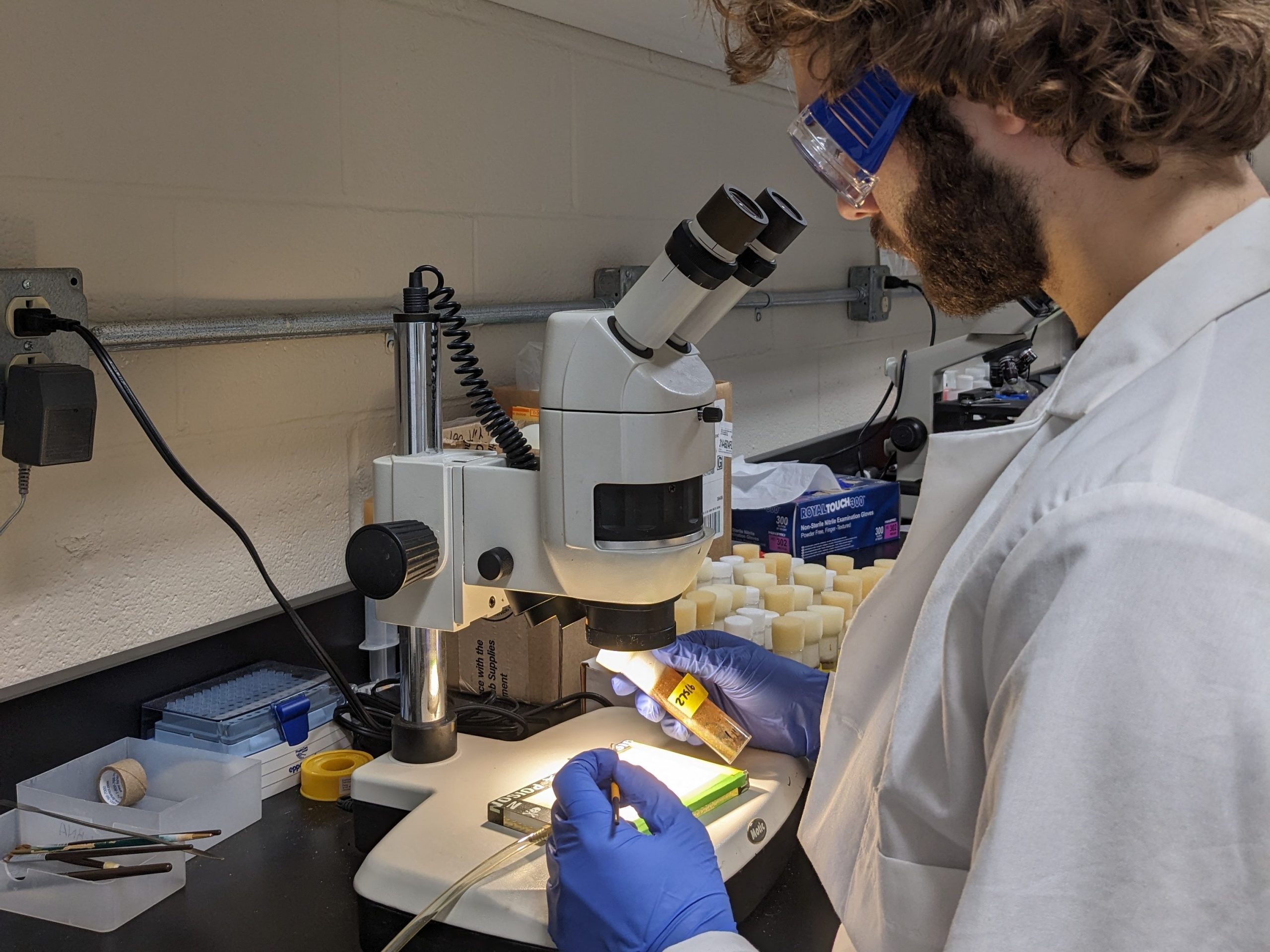
Fundamentally, I am interested in understanding neurodegeneration in the context of age to fabricate therapeutics to support human health. Below are brief overviews of my previous research experiences:
Flynt Research Group
The objective for this research was to identify a ribonuclease that regulates circular RNA (circRNA) turnover. Ultimately, we concluded that RRP6, the catalytic subunit of the nuclear exosome, was most involved in circRNA turnover of the RNases that were assayed. Using Drosophila melanogaster with a drug-inducible GeneSwitch system, we performed molecular and behavioral experiments as well as microscopic visualization to make this determination. These findings establish RRP6’s role in circRNA ribostasis and reveal a therapeutic window where interventions, potentially including genome editing of human RRP6 ortholog EXOSC10, might strengthen neuronal RNA surveillance to forestall functional decline.
Associated report: Serio, J. (2025). Neural RRP6 Depletion Drives circRNA Accumulation and Motor Impairment in Drosophila melanogaster Neurons. The Aquila Digital Community.
Pediatric Storage Disorders Lab
I worked under Dr. Jonathan D. Cooper in the PSDL at Washington University in St. Louis. The aim of this project was to evaluate peripheral nervous system integrity and characterize tissue-specific pathology in CLN1 and CLN3 mouse models of Batten disease, respectively. We found that end-of-life CLN1-deficient mice exhibit variably reduced innervation to sensory corpuscles in the footpads. By contrast, the architecture of esophageal musculature remains intact throughout the lifespan of CLN3-deficient mice. I aided in achieving these findings by performing tissue sectioning, histological and immunological staining, and microscopy.
Publication Pending
The Slotkin Laboratory
In the Slotkin Laboratory at the Donald Danforth Plant Science Center, the goal of this project was to characterize the involvement of two proteins, MORC6 and MOM1, in de novo transgene silencing. Using the model grass Arabidopsis thaliana, we learned that MORC6 is involved in de novo DNA methylation, but is not a main driver. I executed genotyping, bisulfite amplicon sequencing, and TOPO cloning experiments to quantify DNA methylation at a reporter transgene following gene knockout, and our findings were corroborated by Illumina sequencing.
USM Lab of Social Insect Science
Under Dr. Kaitlin Baudier in the USM Lab of Social Insect Science, I studied age-dependent division of labor in Tetragonisca angustula soldiers. The goal of this project was to evaluate differences in physiology, metabolism, and behavior between soldier subcastes to elucidate the mechanism driving this unique division of labor. I quantified flight behaviors across age-correlated castes and performed generalized linear mixed-effects modeling in R, affirming that age drives behavioral differentiation.